
Ontario Lockdown Class Action: What It Means for Your Family Law Rights and Legal Standing
As of 2026, no certified class action lawsuit has been launched specifically challenging Ontario’s pandemic lockdown measures, though the question continues to arise among individuals who experienced significant disruption to their family law matters during government-imposed closures. For those navigating divorce, custody disputes, or support arrangements during that period, the primary legal recourse remains individual claims that document specific, measurable harm rather than participation in a collective lawsuit that does not yet exist.
The pandemic lockdowns affected family law clients in profound ways: court delays stretched for months, scheduled custody hearings were postponed indefinitely, and access to legal services became severely constrained. Many parents struggled with sudden changes to parenting time, others faced financial hardship that delayed support negotiations, and some experienced domestic violence situations that worsened without timely court intervention. The question of whether these harms rise to the level of a class action hinges on whether a group of people suffered similar losses in a way that makes collective legal action more efficient than individual claims.
Understanding the distinction matters. A class action requires common legal and factual issues affecting a defined group, certification by the court, and a representative plaintiff whose experience mirrors that of the class. To date, the varied nature of lockdown impacts on family law clients has not produced the cohesive claim necessary for certification. If you experienced delays, financial loss, or worsened family conflict during lockdowns, documenting your specific circumstances and consulting a family lawyer about individual remedies remains the most practical path forward.
Understanding the Ontario Lockdown Class Action Framework
A class action lawsuit allows a group of people who have suffered similar harm to bring a single legal action together rather than filing individual claims. One or more representative plaintiffs sue on behalf of everyone affected, and if the court certifies the action as a class proceeding, the outcome, whether a settlement or judgment, applies to all members of the defined class. This approach makes sense when many people face comparable injuries from the same conduct or policy, but individual claims would be too small, complex, or costly to pursue alone.
In the context of lockdown measures, potential class action claims could rest on several foundations. Government restrictions during the pandemic, business closures, travel limitations, gathering prohibitions, affected millions of Ontarians. Some might argue these measures violated Charter rights, such as freedom of movement, freedom of association, or security of the person. Others could claim economic damages: lost income, shuttered businesses, or disrupted contracts. Family law clients specifically faced court delays that postponed custody hearings, restricted access to children across jurisdictions, and created enforcement nightmares when parents couldn’t comply with existing orders due to quarantine rules.
For a class action to proceed in Ontario, it must satisfy strict criteria under the Class Proceedings Act. The court must certify that the claims raise common issues suitable for collective resolution, that a class action is the preferable way to resolve those issues, and that the representative plaintiff will adequately represent the class. This certification process can take months or years, and many proposed class actions never get certified.
Without verified details about specific filings, we can’t point to a particular Ontario lockdown class action with named defendants, court dates, or a defined class. What we can say is that if such actions emerge, they would likely target government entities and invoke the kinds of systemic harms described above. Understanding this framework helps you assess whether your experience during lockdowns fits within a potential collective claim or whether individual legal remedies better address your family law challenges.
How Lockdown Measures Affected Family Law Matters

Court Delays and Access to Justice
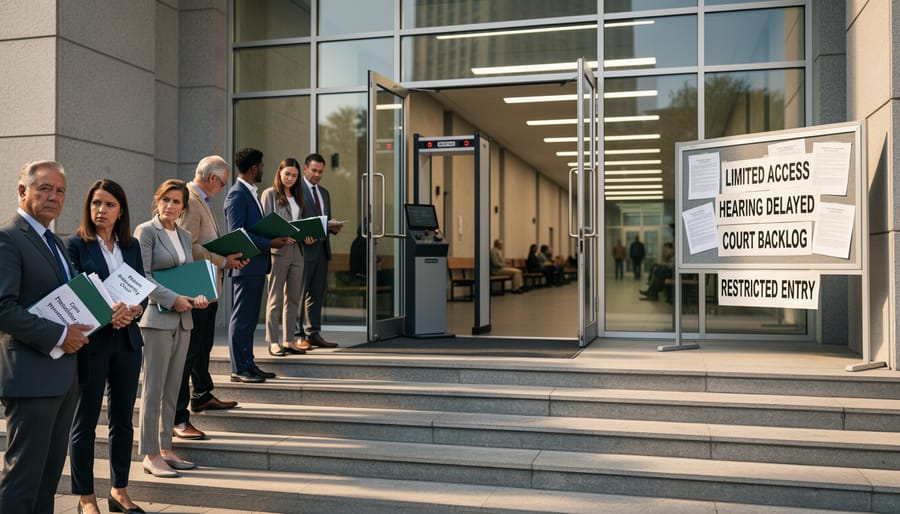
When Ontario declared its first state of emergency in March 2020, family courts shifted abruptly to virtual hearings and restricted in-person proceedings. Many scheduled divorce and custody trials were postponed indefinitely, leaving families in limbo while their legal matters stalled. The backlog grew rapidly as courts struggled to adapt technology and prioritize urgent cases, meaning routine motions and settlement conferences faced months-long delays.
For clients navigating separation, these disruptions translated into real hardship. A custody dispute that might have resolved in weeks stretched into months, prolonging uncertainty for children and parents alike. Financial disclosure deadlines slipped, stalling property division negotiations. Even simple procedural steps required additional waiting as court staff worked remotely with limited capacity. The strain of managing family court during COVID-19 created emotional exhaustion alongside the financial burden of extended legal representation.
Virtual hearings, while necessary, introduced their own challenges. Technical difficulties disrupted proceedings, and many clients found it harder to present evidence or testify effectively from home. The delays weren’t just inconvenient; they affected child support payments, spousal support obligations, and the ability to move forward with life after separation. For those who needed swift court intervention to protect their interests, the pandemic-era access to justice gaps felt particularly acute.
Custody, Access, and Parenting Time Disruptions
Pandemic lockdowns turned everyday custody arrangements into complex legal puzzles. Travel restrictions between regions meant parents couldn’t complete scheduled exchanges, especially when children or caregivers needed to quarantine. A parent who tested positive for COVID-19 often faced impossible choices: violate a court order by withholding the child, or risk the other household’s health by proceeding with the visit. Many courts were closed or operating remotely, making emergency enforcement applications difficult when one parent simply refused access, citing health concerns, legitimate or otherwise.
These disruptions left families in legal limbo. Existing parenting orders assumed normal mobility and predictable schedules, but lockdowns rendered many arrangements unenforceable. Parents who followed public health rules sometimes found themselves accused of contempt, while others weaponized pandemic fears to restrict access without court approval. Communication between separated parents, already strained, deteriorated further under stress, making flexible co-parenting strategies nearly impossible to implement. The result was prolonged conflict, children caught between parents, and a backlog of variation motions that courts couldn’t address in real time. For many families, the damage to relationships and routines persisted long after restrictions lifted.
Economic Impact on Support Obligations
The economic fallout from lockdown measures created immediate and lasting challenges for families navigating support obligations. Business closures and capacity restrictions decimated income streams across sectors, leaving payor parents unable to meet their court-ordered support commitments. Recipient parents, many of whom depended on that support for housing, childcare, and basic needs, faced sudden financial insecurity through no fault of their own.
Income volatility became the norm. Self-employed individuals saw revenue collapse overnight. Employees in hospitality, retail, and personal services lost jobs or hours. Even those who transitioned to remote work often experienced pay cuts or deferred bonuses. These weren’t temporary blips, many families endured months of reduced or eliminated income, creating arrears that mounted quickly and triggered enforcement proceedings.
The gap between legal obligations and economic reality widened. Some payor parents simply couldn’t comply, while others used lockdowns as an excuse to withhold support. Recipient parents struggled to enforce orders when courts were backlogged and enforcement mechanisms slowed. Modification applications piled up, but delays meant families lived with outdated support orders that no longer reflected anyone’s financial circumstances. This mismatch between obligation and capacity fuelled conflict, mistrust, and genuine hardship on both sides of the support equation.
Your Rights and Legal Options as a Family Law Client
Individual Legal Remedies for Lockdown-Related Family Law Issues
If you experienced legal or financial disruption during Ontario’s pandemic lockdowns, individual legal remedies may offer faster, more targeted relief than waiting for a class action to conclude. Family law provides established tools to address the specific harms many clients faced, from sudden income loss to custody complications.
A motion to change support is the primary mechanism when your financial circumstances shifted during lockdowns. If you lost employment, experienced reduced hours, or saw your business revenue collapse due to government restrictions, you can file for divorce or bring a motion to adjust your spousal or child support obligations based on your new income reality. Ontario courts recognize material changes in circumstances, and documented pandemic-related income loss qualifies. You’ll need evidence: tax records, termination notices, business financials showing the decline. The same process works in reverse if your ex-partner stopped paying support during lockdowns without seeking a formal variation.
For custody and access disputes, you can request a variation of your parenting order when lockdown restrictions made compliance impossible or unsafe. Courts understood that travel bans, quarantine requirements, and health concerns created legitimate obstacles. If your ex withheld access citing pandemic fears or you couldn’t exercise parenting time due to border closures, a motion to vary or enforce can clarify your rights and establish a workable schedule moving forward.
These remedies are case-specific and can be resolved in months rather than years, giving you control over your family law outcome.
When a Class Action Might Apply to Your Situation
A class action might apply to your situation if you experienced harm resulting from government policies that systematically affected a group of people, rather than just individual circumstances. For family law clients, this could include scenarios where court closures prevented timely hearings for urgent custody or support matters, creating a pattern of denied access to justice across many families. If lockdown orders directly interfered with court-ordered parenting time or made enforcement of existing orders impossible, and this harm was widespread rather than isolated, you might have standing in a collective claim.
Similarly, if government restrictions prevented you from completing necessary steps in your legal separation or divorce process, such as mandatory mediation sessions, financial disclosure meetings, or property valuations, and this created measurable financial or emotional harm, these systemic barriers could form the basis of a class action claim.
However, it’s crucial to understand that eligibility depends entirely on how the class is defined in any actual lawsuit, and those specifics remain unverified at this time. Not every lockdown-related hardship qualifies for a class action. Individual disputes or unique family circumstances typically require individual legal remedies rather than collective claims. Consulting with an experienced family law attorney can help you determine whether your situation fits a potential class action or whether pursuing individual relief would better serve your needs.
What to Do If You Believe You Were Harmed

If you believe you suffered legal, financial, or emotional harm as a result of lockdown measures, taking organized, deliberate steps will help you understand your options and protect your rights. Many family law clients faced real disruption during this period, from postponed court dates to lost parenting time, and legal remedies may be available to address that harm. Here’s how to move forward:
- Document your specific harm in detail. Write down how lockdowns affected your case: delayed court orders, missed custody exchanges, income loss that impacted support payments, or inability to access legal services. Include dates, communications, and any evidence of how restrictions directly interfered with your family law matters.
- Gather all relevant court documents and correspondence. Collect copies of court orders, emails with your former spouse or their lawyer, court notices, financial records showing income changes, and any other documentation that supports your claim of harm. This paper trail will be crucial for any legal assessment.
- Consult a family law lawyer to assess your situation. Professional family lawyer advice will clarify whether your harm is best addressed through individual legal action, participation in a potential class action, or both. An experienced attorney can evaluate the strength of your claim and recommend the most effective path.
- Explore both individual remedies and potential class action participation. Your lawyer can help you weigh options such as motions to change support, enforcement applications, or custody variations against the possibility of joining a class action if one proceeds. Individual claims often provide faster, more tailored relief for family law issues.
- Take timely action to preserve your legal rights. Limitation periods may apply to certain claims, and delay can weaken your case. Acting now ensures you don’t forfeit potential remedies, whether through individual proceedings or collective legal action.
You don’t need to navigate this alone. Legal support is available, and understanding your options is the essential first step toward resolution. A consultation will help you determine the best course of action based on your unique circumstances, ensuring that past harms don’t continue to affect your family’s future.
Common Questions About Lockdown Class Actions and Family Law
Families navigating divorce and custody matters during the pandemic faced unprecedented challenges, and many now wonder whether they have legal recourse. Here are answers to the most common questions we hear from clients about lockdown-related class actions and how they intersect with family law.
Can I join a class action if I had custody or support issues during lockdowns?
Your eligibility depends on the specific claims and class definition of any filed lawsuit, which remain unverified at this time. Generally, class actions address systemic harms affecting many people similarly, such as denial of court access or government policies that broadly impacted families, rather than individual custody or support disputes.
Will participating in a class action help resolve my current divorce or custody case?
No. Class actions address past collective harm and potential compensation, but they won’t change custody orders, modify support payments, or speed up your ongoing family law matter. Individual motions and applications remain the most direct path to resolving current family law issues.
How long do class action lawsuits typically take?
Class actions often take years to resolve, involving certification hearings, discovery, potential appeals, and settlement negotiations. If you need immediate relief for family law matters affected by lockdowns, individual legal remedies will provide faster results than waiting for a class action to conclude.
What kind of compensation might be available through a lockdown class action?
Potential remedies could include financial compensation for documented losses, though the specific damages and amounts depend entirely on the claims proven and any settlement reached. Family law clients should understand that compensation, if any, would address collective economic or rights-based harm, not individualized custody or support disputes.
Many clients also ask about legal fees. Class actions typically operate on a contingency basis, meaning lawyers receive payment from any settlement or award rather than charging upfront fees to participants. You wouldn’t pay out-of-pocket to join an approved class action, though individual family law matters still require separate legal representation.
The timeline question deserves realistic expectations. Certification alone can take a year or more, and the entire process from filing to resolution often spans three to five years. That’s why we emphasize pursuing individual remedies for urgent family law needs rather than waiting for class action outcomes.
What matters most is understanding your specific situation. If lockdowns disrupted your custody arrangement, delayed your divorce, or created support payment disputes, you have options now. Documenting what happened, preserving communications and court records, and consulting with a family law attorney gives you clarity about both immediate remedies and potential future claims. Whether through individual motions, settlement negotiations, or eventual class action participation, the first step is understanding your rights and the tools available to protect them.
The pandemic lockdowns created real and lasting challenges for families navigating separation, divorce, and custody disputes in Ontario. Court delays, disrupted parenting schedules, and sudden economic hardship compounded an already difficult time, leaving many people feeling overwhelmed and unsure of their legal standing. While the potential for class action litigation addresses broader systemic issues, your family law concerns deserve immediate, individualized attention.
Whether you experienced postponed hearings that prolonged your divorce, custody arrangements that became unworkable during restrictions, or income changes that affected your support obligations, you have legal options. Understanding the difference between collective remedies and the tailored solutions available through motions to change, custody variations, or enforcement applications is essential to protecting your rights and moving forward.
You don’t have to navigate these challenges alone. Our firm is committed to helping Ontario families through both the lingering effects of pandemic disruptions and the ongoing complexities of family law. We offer compassionate, experienced guidance tailored to your unique situation. Contact us today for a free consultation to discuss your specific circumstances and explore the legal remedies available to you. Timely advice can make all the difference in resolving past harms and securing a stable future for you and your family.