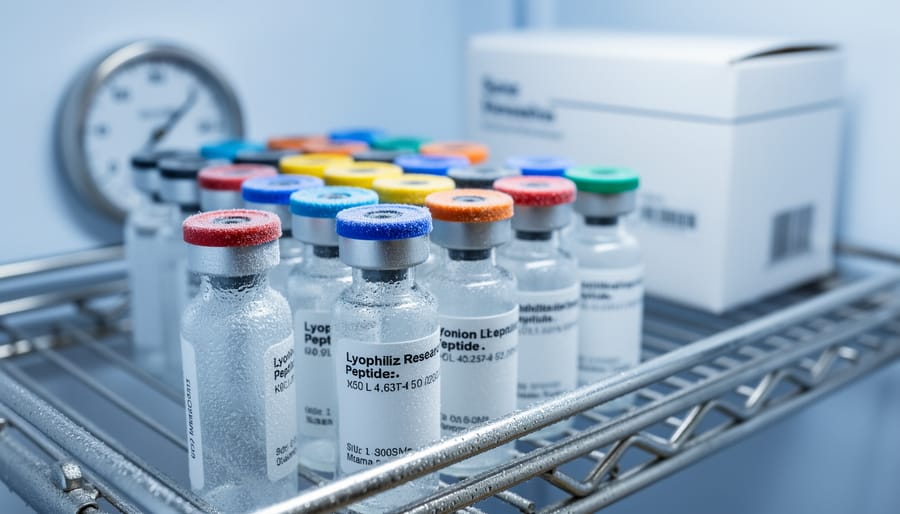
How to Store Research Peptides in the Freezer, Fridge or at Room Temperature
Lyophilized research peptides keep best in a freezer at -20°C, with the fridge at 2 to 8°C reserved for short-term use, and if you plan to buy research peptides from a US lab room temperature is acceptable only for brief periods, such as shipping or a few days on the bench. Once a peptide is reconstituted, it belongs in the fridge, never at room temperature, and it should be used within a few weeks. Getting this right takes about five minutes of setup and no special skill, just a stable cold space and a few basic supplies.
The reason this matters is simple. Peptides are fragile chains of amino acids, and heat, moisture, light, and repeated freeze-thaw cycles break them down quietly. You won’t see the damage. A vial that looks perfectly fine can have lost much of its potency, which undermines whatever work you’re doing with it. Proper storage is what protects that investment from the moment the package arrives.
This guide walks through each environment, when to use it, and the mistakes that most often ruin good material. If you’re unsure which approach fits your situation, our free consultation is a reassuring place to start, and many people tell us a quick conversation was all they needed to feel confident.
Why Storage Temperature Matters for Peptide Stability
Peptides are chains of amino acids, and those chains are more fragile than they look. Much like keeping important documents in a dry, secure place so they remain reliable when you need them, peptides depend on a stable environment to stay intact. When conditions slip, the material can degrade quietly, long before anything looks wrong.
Several factors do the damage, and they often work together:
– Heat speeds up chemical reactions, so the bonds holding a peptide together break down faster as temperatures rise.
– Moisture is a major culprit. Water can split peptide bonds through a process called hydrolysis, and it also lets other unwanted reactions occur.
– Lightespecially ultraviolet, can alter sensitive amino acids and reduce potency.
– Oxygen can oxidize certain amino acids, such as methionine and cysteine, changing the structure of the peptide.
– Repeated freeze-thaw cycles stress the material each time it changes state, which can cause clumping, loss of structure and gradual degradation.
Not every peptide reacts the same way, because stability depends on the specific amino acid sequence. Some are quite hardy, while others are notably delicate.
The form of the peptide matters just as much as the environment. Lyophilized (freeze-dried) powder has had most of its water removed, which makes it far more stable and well suited to longer storage. Once a peptide is reconstituted into a solution, it is in a liquid state where water is present, and degradation can happen much more quickly. A powder might stay viable for months or years under good conditions, while a reconstituted solution may only hold up for days or weeks, even when refrigerated.
This is why storage decisions deserve a little care from the start. Choosing the right temperature and protecting against moisture, light and air helps preserve purity and potency, and it keeps your work dependable.
What You Need Before You Store: Tools, Materials and Labelling Basics
Good storage starts before a single vial goes into the freezer. Gathering a few inexpensive supplies up front keeps your peptides stable and your records tidy, much like setting up a filing system before the paperwork piles up. Here is what to have on hand:
- Original sealed vials, kept in the packaging the supplier used.
- A dedicated freezer or fridge shelf with a reliable standalone thermometer.
- Airtight secondary containers to hold vials and block out moisture.
- Desiccant packs to absorb stray humidity inside each container.
- Opaque boxes or foil wrapping to shield vials from light.
- Clean, lab-grade gloves for handling.
- Adhesive labels and a permanent marker that won’t smudge in the cold.
- A simple storage log, on paper or in a spreadsheet.
The thermometer deserves special attention. A freezer’s built-in dial tells you what the unit is aiming for, not what’s actually happening inside. Frost-free models are especially worth watching, because they run periodic defrost cycles that warm the interior for a short time. Those small swings can be enough to stress a lyophilized peptide over months, so a thermometer that records minimum and maximum temperatures is a worthwhile purchase.
Location matters too. Door shelves are the warmest, least stable spot in any appliance, since they’re exposed to room air every time someone reaches inside. Choose a spot toward the back, on an interior shelf, where temperatures stay steadier.
When you label each container, note the peptide name, the date received, and the date of any reconstitution. Clear labels and a consistent log mean you never have to guess what’s in a vial or how long it has been stored.
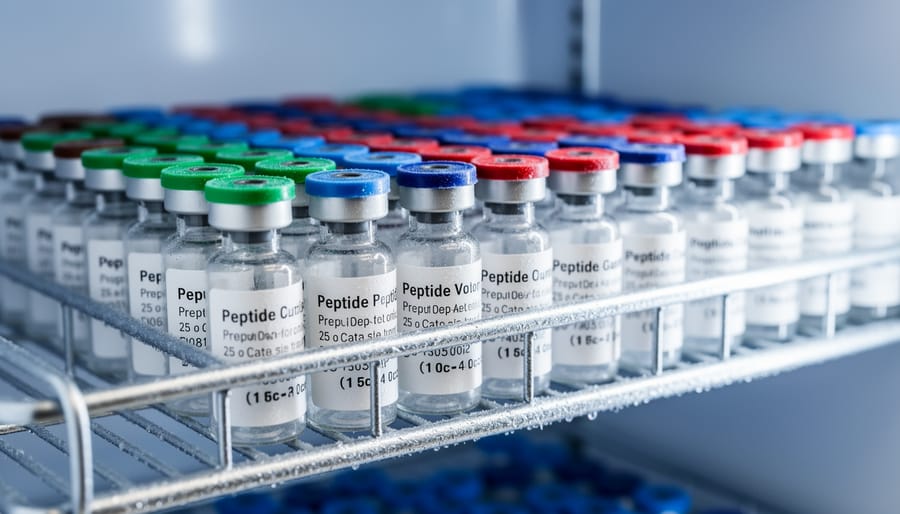
Safety Warnings and When to Stop and Reassess
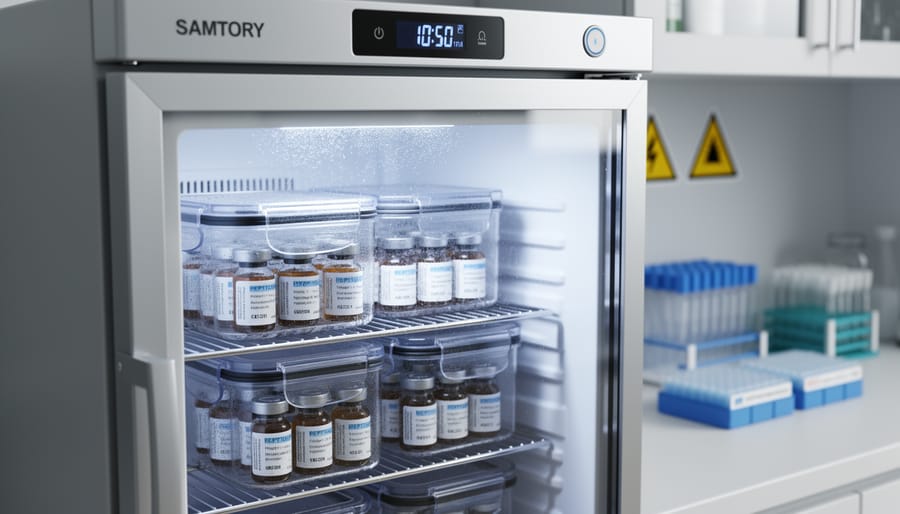
Careful storage starts with a clear understanding of what these materials are and aren’t. Peptides sold for research are intended for laboratory use only. They are not for human consumption, and nothing in this guide suggests otherwise. Always follow your supplier’s handling instructions and the regulations that apply where you live and work, since requirements can differ by province and by institution.
Beyond that, a few sensible habits reduce risk. If you must keep vials in a shared household fridge or freezer, store them in a sealed, clearly labelled container away from food, and mark it so no one mistakes it for something else. Keep everything out of reach of children and pets, ideally in a closed container on a high or secured shelf.
It also helps to know when to stop and reassess instead of pushing ahead. Discard the material, rather than risk working with something compromised, if any of the following applies:
- The powder has changed colour, looks collapsed or damp, or no longer resembles how it arrived.
- A reconstituted solution looks cloudy, discoloured or contains floating particles.
- The cap, stopper or seal is cracked, loose or appears to have been tampered with.
- The vial has been through an unrecorded stretch of heat, such as a warm vehicle or a sunny windowsill.
- You can’t confirm how long it has been stored or at what temperature.
When in doubt, set the vial aside and check the supplier’s guidance. Replacing one vial is far less costly than building your work on unreliable material.
Step-by-Step: Storing Peptides in the Freezer, Fridge or at Room Temperature
Long-Term Storage in the Freezer
Unopened lyophilized peptides keep best in the freezer, typically around -20°C. Some suppliers prefer colder storage, such as -80°C, when the vial will sit for many months or years, so check the product’s own guidance before you settle on a temperature.
The goal is a stable, dry, undisturbed environment. Here is a practical sequence from the moment a vial arrives:
- Inspect the vial on arrival. Confirm the seal is intact and the powder looks like a uniform cake or film, with no moisture or discolouration.
- Label the vial with the received date and the peptide name using a permanent marker or a freezer-safe label.
- Place it in an airtight secondary container with a fresh desiccant pack, keeping the original vial sealed.
- Store the container at a stable spot at the back of the freezer, away from the door and any defrost cycle.
- Record the vial, date and location in your storage log.
- When you need it, move the container to the bench and let the vial reach room temperature before you open it.
That last step matters more than it looks. Opening a cold vial lets room air flood in, and moisture condenses on the powder. Even a small amount of water can speed degradation, so give it a good 20 to 30 minutes before the seal is broken.
Door openings are the other quiet culprit. Every time the door swings wide, the temperature climbs briefly, and in a frost-free freezer those swings add up over weeks. Keep your peptide container in one place and open it as rarely as you can.
If you expect to use only part of a peptide at a time, plan ahead. Aliquoting, which means dividing the material into smaller portions, lets you thaw just what you need and avoids repeated freeze-thaw cycles on the whole supply. Follow the supplier’s instructions when doing so, since handling steps can vary by product.
Short-Term Storage in the Fridge
The fridge is the workhorse for peptides you plan to use soon. A standard refrigerator holds a steady 2°C to 8°C, which suits lyophilized peptides you expect to use within a few weeks to a few months, and it is the right place for any peptide once it has been reconstituted.
Placement matters as much as temperature. Set vials upright on a middle shelf toward the back, where readings stay most stable. Keep them away from the door, which warms every time it opens, and away from cooling vents, where a vial can partly freeze and thaw. Shield each vial from light with its original box or a foil wrap, and keep it in a small airtight container so stray moisture and food odours stay out.
Reconstituted solutions are far less stable than dry powder, so the clock starts the day you add the diluent. Write that date on the vial and follow the window given by your supplier or the relevant literature. Those windows vary by sequence, so don’t assume a number from one peptide applies to another. If a solution turns cloudy, shows particles, or you can’t confirm its date, set it aside and don’t use it.
Room Temperature: When It Is Acceptable and When It Is Not
Room temperature is generally acceptable only for short stretches, such as shipping, transit or brief benchtop handling while you prepare a vial for use. It is not a place to leave peptides for weeks or months. Many lyophilized peptides tolerate a few days at ambient conditions without noticeable loss, which is why suppliers can ship them without cold packs, but that tolerance has limits.
Stability also varies by peptide sequence. Some sequences are quite robust, while others, particularly those containing methionine, cysteine, tryptophan or asparagine residues, degrade faster when exposed to warmth, moisture or oxygen. It is a mistake to assume that because one vial held up well on a shelf, another will behave the same way.
When a vial must sit out, keep conditions cool, dry and dark. Choose a spot away from windows, radiators, equipment that gives off heat and humid areas such as sinks. Keep the vial sealed and, ideally, inside a closed container with a desiccant pack. Never leave vials in a parked car, a mailbox or direct sunlight.
Most importantly, follow the product’s own guidance. The certificate of analysis and supplier instructions will state what that specific peptide can handle. When in doubt, return it to the fridge or freezer rather than gamble with its integrity.
Quick Comparison of Storage Options
Choosing a storage environment usually comes down to two questions: how soon will you use the peptide, and has it been reconstituted? This summary puts the three options side by side so you can decide with confidence. Always defer to the supplier’s certificate of analysis for peptide-specific limits.
| Option | Typical temperature | Best for | Typical duration | Key precautions |
|—|—|—|—|—|
| Freezer | About -20°C or colder | Unopened lyophilized peptides, long-term storage | Months to years, depending on the peptide | Keep sealed, add desiccant, aliquot, avoid repeated freeze-thaw cycles |
| Fridge | 2°C to 8°C | Lyophilized peptides used soon; reconstituted solutions | Weeks to a few months; reconstituted solutions follow supplier guidance | Store upright, away from the door and vents, protect from light |
| Room temperature | Cool, dry, dark conditions | Short periods such as shipping or brief benchtop handling | Days to a few weeks at most, varying by sequence | Avoid heat, humidity and sunlight; follow the product’s own guidance |
When in doubt, the colder and drier option is the safer default for unopened material.
Common Storage Mistakes and How to Avoid Them

Almost everyone makes a storage slip at some point, and most of them are easy to correct once you know what to look for. Think of it the way you would approach any careful process: the same common mistakes tend to trip people up, and a small adjustment in habit usually prevents them. Here are the ones we see most often, each paired with a simple fix.
- Repeated freeze-thaw cycles: divide material into single-use aliquots so each portion is thawed only once.
- Opening a cold vial straight from the freezer: let it reach room temperature first so condensation doesn’t form inside.
- Storing vials in the fridge door: move them to a stable middle shelf, away from the door and cooling vents.
- Leaving vials in sunlight or a warm vehicle: keep them in a dark, cool spot and transport them in an insulated container.
- Poor labelling: mark every vial with the peptide name, date received and storage conditions.
- Mixing up reconstitution dates: write the date of reconstitution directly on the vial and record it in your storage log.
None of these errors means your work is ruined, and a clear, consistent routine makes most of them unlikely. If you do spot a lapse, such as a vial left out overnight, check the supplier’s guidance and your certificate of analysis before deciding whether the material is still suitable. When in doubt, it is wiser to set it aside than to risk compromised results.
Verifying Your Storage Setup and Planning Next Steps
Once your vials are stored, confirm the setup is actually working. Check your thermometer at the same time each day, or at least weekly, and write down the reading. A dated log of readings, storage dates and reconstitution dates makes drift easy to spot. If the temperature wanders outside the range your supplier recommends, move the vials and note what happened.
Before each use, look at the vial closely. Clear liquid or an intact powder cake is what you want; discolouration, cloudiness, particles or a damaged seal means it’s time to discard. Reread the certificate of analysis and the supplier’s handling guidance, since limits differ from one peptide to the next. Use older stock first so nothing sits forgotten at the back of the freezer.
If a peptide-specific question comes up that the paperwork doesn’t answer, contact your supplier or a qualified laboratory professional rather than guessing. Careful record-keeping serves people well in many areas of life, and that includes separation. If you’re in Ontario and facing divorce, documentation can help protect your future and our family law resources are a good place to start. You’re also welcome to book a free consultation with Ontario’s Divorce Lawyer.
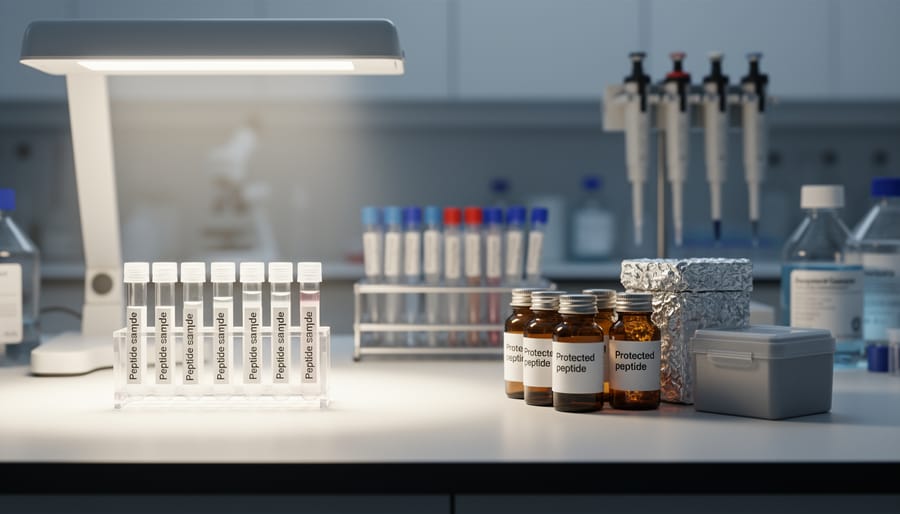
Frequently Asked Questions About Peptide Storage
Most storage questions come down to one idea: protect the peptide from heat, moisture and light, and follow your supplier’s documentation for the specifics. The answers below are general, so treat the certificate of analysis as the final word for any particular product.
How long do lyophilized peptides last in the freezer?
Stored sealed, dry and protected from light, many lyophilized peptides stay stable for a long time, but the exact window depends on the sequence. Check your supplier’s documentation for the stated shelf life rather than relying on a general figure.
Can I refreeze a reconstituted peptide?
Repeated freeze-thaw cycles can damage peptides, which is why aliquoting into single-use portions is so helpful. If you must freeze a reconstituted solution, do it once, and confirm with your supplier whether that is appropriate for your product.
Is a household fridge acceptable?
Yes, as long as it holds a steady cool temperature, typically 2°C to 8°C, and the vials sit upright on an interior shelf away from the door. Keep them clearly labelled and separate from food.
What happens if a vial was left out overnight?
It depends on the peptide, the room temperature and whether it was reconstituted. Inspect it for cloudiness, particles or discolouration, and when in doubt, contact your supplier or discard it rather than risk compromised material.
It also helps to keep a simple, dated record of when each vial was received, opened and moved. Much like keeping tidy documentation during the divorce process clear records make it far easier to see what you have and how it has been handled. If a question isn’t answered by your supplier’s paperwork, reach out to them or a qualified laboratory professional before proceeding.
Store lyophilized peptides in the freezer for the long term, keep them cool and dry in the fridge for short-term use, and treat room temperature as a brief, temporary option. Once reconstituted, peptides belong in the fridge. A steady routine of labelling, logging and checking your thermometer protects your work far better than any single trick.
Careful habits really do add up, and clear, patient explanations make complicated topics far easier to manage. If you’re in Ontario and have questions about separation or divorce, a free consultation with Ontario’s Divorce Lawyer, a trusted family lawyer is a gentle first step.